Direct delivery to site of action
The drug is delivered directly to the respiratory tract, allowing acetylcysteine to act on the mucus where its mucolytic effect is required, rather than relying on systemic distribution to reach the airways.
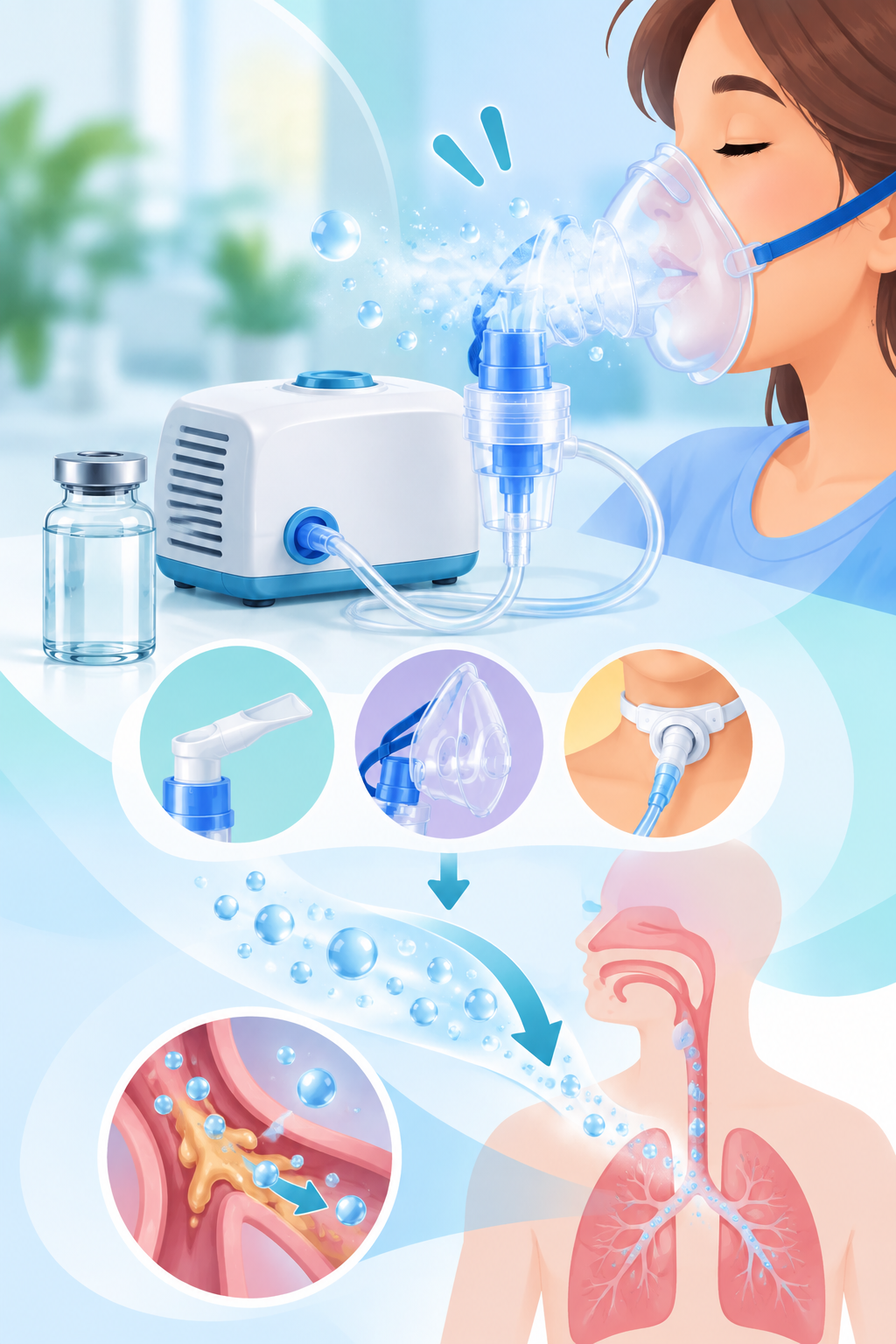
The proposed dosage form is a 20% w/v acetylcysteine nebulising solution, administered by inhalation using a nebuliser. A nebuliser converts the liquid solution into fine aerosol droplets that can be inhaled into the respiratory tract. Acetylcysteine may be administered using conventional plastic or glass nebulisers, and the device must generate an appropriate range of particle sizes for retention within the respiratory tract. The solution may be administered through a mouthpiece, face mask or tracheostomy, depending on the patient's clinical requirements (DailyMed, 2025).
This route was selected because acetylcysteine acts as a mucolytic on respiratory secretions. Inhalation allows the formulation to be delivered directly to the respiratory tract, where acetylcysteine can interact with mucus and reduce its viscosity. A nebulising solution is therefore appropriate for patients requiring acetylcysteine therapy through the respiratory route, while also providing an alternative route for patients who may not be suitable for oral administration.
The drug is delivered directly to the respiratory tract, allowing acetylcysteine to act on the mucus where its mucolytic effect is required, rather than relying on systemic distribution to reach the airways.
Unlike other acetylcysteine formulations, this one bypasses the GI tract and is not subject to first-pass hepatic metabolism. This improves local bioavailability and preserves more of the active drug.
Direct delivery of acetylcysteine to the airways allows the drug to come into contact with respiratory mucus at the site of administration. This makes nebulisation useful when a local mucolytic effect is required, particularly in patients with significant airway secretions.
Smaller total doses are needed compared to oral or IV administration, because the drug is delivered locally. A decreased dose of nebulising solution achieves the same therapeutic effect at the target site as a larger oral or IV dose, with reduced risk of systemic side effects.
The nebulising solution is useful for patients who have difficulty swallowing, are unconscious, intubated, or are otherwise unable to take oral medication, since the solution is administered via a nebuliser.
The fraction of drug reaching the lower respiratory tract can vary widely depending on the type of nebuliser, breathing pattern and patient technique. This makes the dose less predictable than with other controlled routes.
Effective dosage depends on the functionality of the equipment (compressor, mouthpiece, etc.) and the patient's ability to remain appropriately positioned and breathe through the device during treatment, which may be challenging in emergency or resource-limited settings.
Acetylcysteine has a sulfurous odor and can act as a respiratory irritant in some patients. This could trigger reflex bronchospasm or coughing, particularly in those with asthma or hyperreactive airways.
Nebulising components must be cleaned after every use to prevent microbial growth and biofilm formation. This adds a maintenance burden and risk of infection if not properly cleaned.
Patients with cognitive impairment, severe respiratory distress or reduced ability to cooperate may have difficulty using a mouthpiece or mask correctly, which can reduce effective aerosol delivery to the respiratory tract.